Melt pump in plastic flat wire drawing production line
Colleagues who make PP woven bags and plastic flat wire drawing should have a deep understanding that the most troublesome issues in drawing production are uneven thickness of flat wire, frequent wire breakage, and fluctuating quality of finished products. Often times, it's not a matter of raw materials, but rather fluctuations in extrusion flow rate and pressure. In the flat wire drawing production line, the melt pump is a key supporting equipment for stabilizing the silk and reducing losses.
The essence of the melt pump is a positive displacement conveying equipment, and its core value is precise pressure stabilization and quantitative conveying, offsetting the flow and pressure fluctuations caused by the extruder, and solving old problems such as uneven flat wire diameter, high wire breakage rate, and unstable batch quality from the source. Below, Zhengzhou Batte will explain its role and advantages in PP wire drawing.
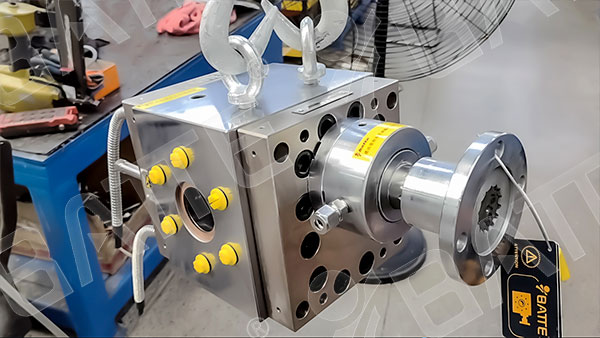
Accurate voltage regulation measurement, more uniform flat wire specifications
In the production process of flat wire, the stability of the die discharge directly determines the thickness of the film and also determines the line density of the subsequently cut flat wire.
When no melt pump is added, the extruder is easily affected by unstable feeding, fluctuations in screw speed, changes in melt temperature, and changes in filter blockage resistance, resulting in fluctuating pre mold pressure and discharge flow rate.
After installing the melt pump, it has linear conveying characteristics. When the speed is stable, the output flow rate is basically proportional to the speed, and the measurement is accurate. It can also isolate the pressure pulsation of the upstream extruder, keep the inlet pressure of the die stable, and ensure that the molten material flowing out of the die lip is uniform and smooth.
The intuitive effect is that the thickness deviation of the film is reduced, the width and thickness consistency of the cut flat wire is better, the wire diameter is uniform, and the waste generated by size deviation is significantly reduced.
Share the pressure building load of the extruder, save electricity, and extend the life of the host
PP melt itself has viscosity, and the material experiences significant resistance when passing through screen changers, pipelines, and molds.
Without a melt pump, the extruder screw has to plasticize the raw materials while also undertaking the task of establishing high pressure. The screw has high back pressure, high axial force, fast wear, and high motor load. After installing the melt pump, the pressure building and boosting work is handed over to the melt pump, and the extruder can operate at low pressure and low temperature.
The benefits are very practical: the load on the extrusion host decreases, the energy consumption per unit output decreases, and low-temperature extrusion can also be achieved; The axial force on the screw and barrel is significantly reduced, resulting in slower wear and directly extending the service life of the extruder and reducing the maintenance cost of the main engine.
Reduce wire breakage, facilitate linkage self-control, and improve continuous production efficiency
Unstable material flow is one of the main causes of wire breakage in drawing. Sudden pressure changes and flow fluctuations can easily lead to material flow interruption and stretching resonance. During drawing, frequent wire breakage occurs, and workers have to stop connecting, resulting in a decrease in output.
The output of the melt pump is stable, the material flow pulsation is small, the frequency of wire breakage is significantly reduced, and the continuity of the production line is better.
Moreover, the speed of the melt pump is controllable and can be synchronously linked with the traction and winding equipment. By collecting import and export pressure and temperature signals, the entire extrusion process can achieve online monitoring and closed-loop adjustment, which is more suitable for automated and stable production.
When selecting a melt pump for wire drawing, it is important to pay attention to these points
Matching displacement and output: Select the appropriate displacement based on the hourly output of the production line and the viscosity of the PP melt to ensure that the pump operates in the high-efficiency range for a long time;
Wear resistant material selection: If a large amount of recycled PP is used, the melt is prone to contain hard impurities. Nitrogen resistant wear-resistant materials are preferred for pump bodies and gears to improve their service life;
Inlet feeding and sealing: Ensure sufficient inlet feeding, fill the tooth slot with material, and avoid empty suction and idling; Match spiral seal or packing seal according to process temperature and pressure to prevent melt leakage;
Power on preheating: Cold start must be fully and evenly preheated to allow the pump body to reach the PP melting temperature. Do not force start, otherwise excessive resistance may damage the drive and pump body.
In general, the PP flat wire drawing production line equipped with a melt pump is not just a simple addition of one device, but an optimization and upgrade of the entire extrusion process. Stable pressure, precise material control, solving the pain point of flat wire size deviation, while reducing energy consumption and slowing down the wear of the main machine, have a significant impact on the quality of finished products and production efficiency in the long run.
For friends who are engaged in flat wire drawing and woven bag production lines, if they are troubled by broken wires, uneven wires, and a lot of waste products for a long time, they can evaluate the melt pump transformation plan based on their own output, return ratio, and process pressure.
Email: sale@meltpump.com
WhatsApp: +86 158 3833 1071