Melt pumps make extrusion more stable and precise
As a core component of modern polymer extrusion production lines, the melt pump serves as the line’s “pressure stabilizer, metering expert, and energy-saving specialist.” By utilizing gear meshing to achieve positive displacement forced conveyance, it effectively isolates pressure fluctuations from the upstream extruder, providing a stable and precise melt supply to the downstream die. This fundamentally enhances product quality and production efficiency.
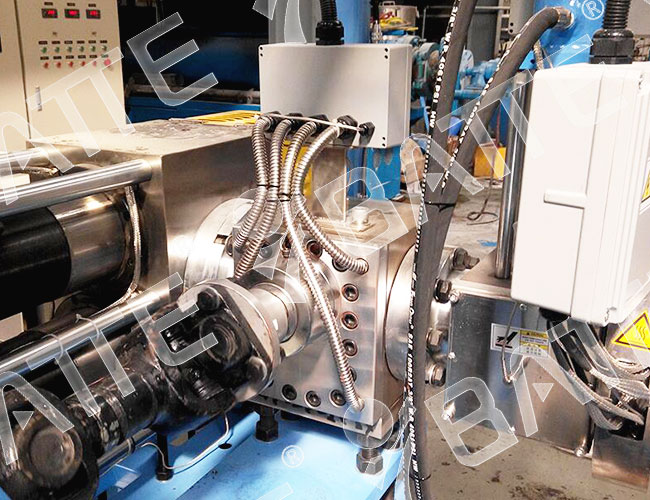
I. Three Key Functions of Melt Pumps
1. Pressure Boosting and Stabilization to Eliminate Output Pulsation
During operation, the extruder screw generates periodic pressure pulsations, which directly cause uneven material discharge and inconsistent product thickness. The melt pump creates a dynamic pressure barrier through high-precision gear meshing, isolating upstream pressure fluctuations at the pump inlet. This controls outlet pressure fluctuations within **±0.5%**, providing the die with a continuous and stable melt pressure and significantly improving discharge uniformity.
2. Precise metering ensures product consistency
As a typical positive displacement conveying device, the melt pump exhibits a strictly linear relationship between flow rate and rotational speed, with a fixed and controllable displacement per revolution. When combined with a variable frequency drive system, it achieves **high-precision flow control within ±1%**, keeping critical dimensional tolerances—such as film thickness and pipe wall thickness—within an extremely narrow range, thereby significantly improving product appearance and dimensional consistency.
3. Energy Savings and Efficiency Improvements, Reducing Overall System Load
The melt pump can independently handle the system’s primary pressure-building tasks, allowing the extruder to operate under lower backpressure conditions. This effectively reduces shear heat generation, lowering overall energy consumption by 15%–30%. At the same time, it increases output per unit time, reduces equipment wear, and extends the service life of both the extruder and the die.
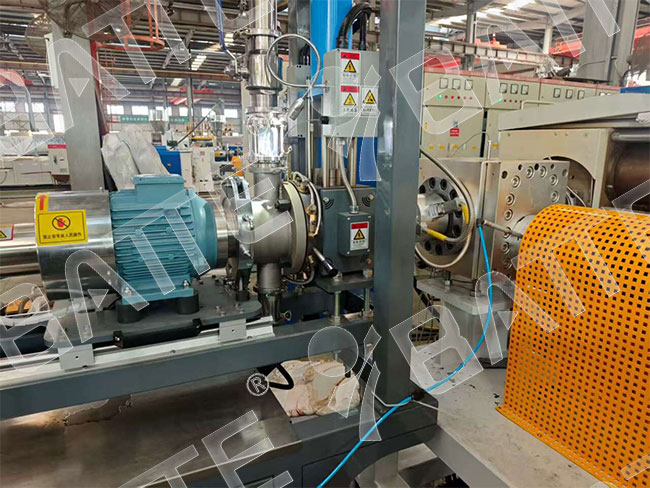
II. Working Principle of the Melt Pump: Three Steps to Ensure Stable Conveyance
Suction Phase
The drive gear rotates the driven gear in the opposite direction, creating a vacuum in the suction chamber and drawing the high-temperature, high-viscosity melt into the tooth-groove spaces.
Pressurization and Conveyance Stage
The melt is sealed within the enclosed chamber formed by the tooth slots and the pump body. As the gears rotate, the melt is smoothly pushed toward the outlet. The chamber volume gradually decreases, achieving continuous pressurization, with a maximum operating pressure of up to 35 MPa.
Stable Discharge Stage
The gears maintain precise meshing, smoothly discharging the melt at a constant pressure. The flow rate remains unaffected by fluctuations in die resistance, ensuring pulsation-free, stable discharge.
The equipment utilizes involute helical gears, minimal meshing clearance (≤0.1 mm), and a specialized high-temperature sealing structure, enabling the stable conveyance of high-viscosity melt with viscosities up to 30,000 Pa·s and accommodating a wide range of demanding extrusion conditions.
Email: sale@meltpump.com
WhatsApp: +86 158 3833 1071