Why Are Melt Pumps Standard Equipment on Production Lines?
Any business owner involved in film, sheet, pipe, or modified plastic extrusion knows that high-end production lines must be equipped with melt pumps. This isn’t a waste of money—it’s an essential requirement for reducing costs and improving quality!
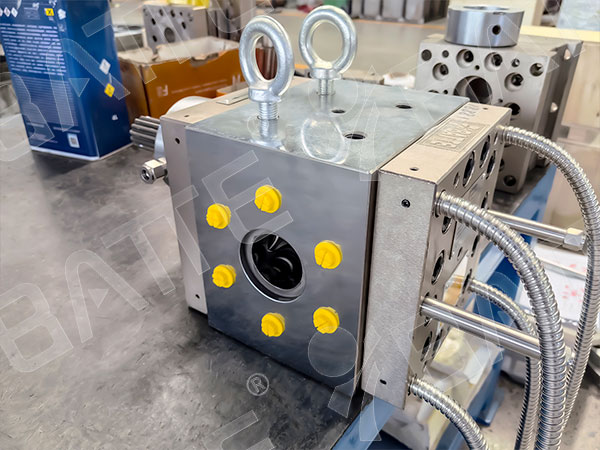
I. Core Rationale: Delegating Tasks to Free Up the Extruder
Conventional extruders perform two roles at once: they must both melt and plasticize the material and deliver it under high pressure. Screws inherently cause flow pulsations, resulting in output that fluctuates between fast and slow.
A melt pump is installed between the screen changer and the die head. Through its piping system, it boosts pressure, stabilizes pressure, and provides precise metering. This allows the extruder to focus solely on mixing and plasticizing, completely decoupling upstream and downstream pressures.
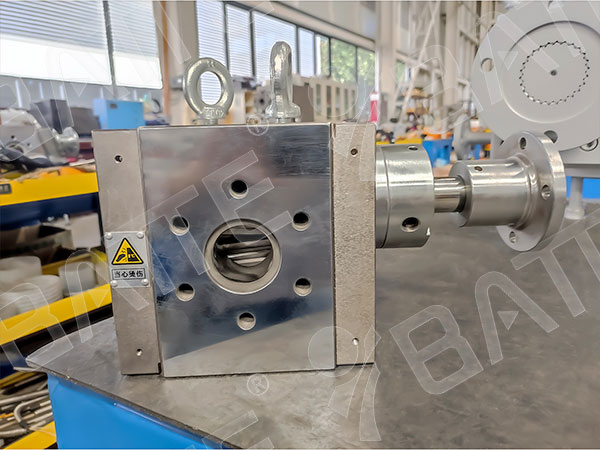
II. 4 Irreplaceable Core Functions
1. Stable Pressure and Flow: Eliminates Product Defects at the Source (Most Critical)
The screw’s inherent pressure fluctuations of ±10%–15% directly cause film striping, uneven pipe wall thickness, large sheet tolerances, and numerous crystalline spots and bubbles.
The melt pump’s positive-displacement gear delivery locks die pressure fluctuations within ±1%, with flow rate error ≤0.5%. This directly improves thickness uniformity and reduces scrap rates by 20%–30%, making it indispensable for high-end optical films and multilayer co-extrusion.
2. Precise Metering, Controllable and Scalable Output
The pump delivers a fixed volume per revolution, with flow rate linearly linked to rotational speed; adjusting the pump speed allows for precise control of production capacity.
By relieving the extruder of the burden of pressure buildup, the screw no longer has to withstand high pressure, allowing for higher maximum rotational speeds. This increases the production capacity of the entire line by 15%–30%, speeds up changeovers and adjustments for material and specification changes, and reduces downtime losses.
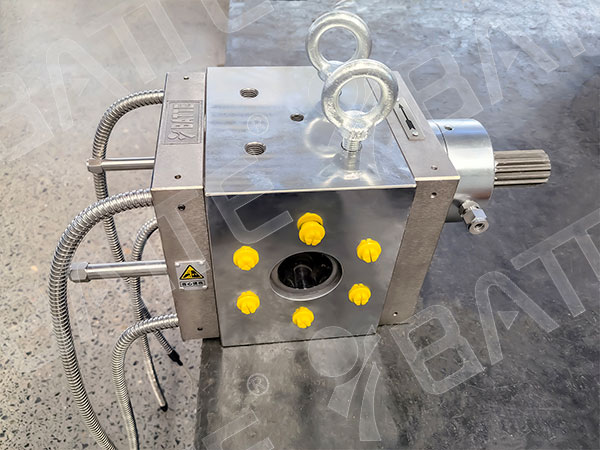
3. Reduced Load, Energy Savings, and Extended Main Unit Lifespan
With the melt pump fully handling high-pressure build-up, the extruder’s back pressure is significantly reduced, cutting wear on the screw, thrust bearings, and gearbox in half; Overall energy consumption drops by 10%–25%. Reduced shear heat prevents material from remaining at high temperatures for extended periods, which would otherwise cause carbonization and yellowing, resulting in more stable processing of modified and filled materials.
4. Suitable for Complex, High-End Processes
It ensures stable pressure for long-line conveying, high-viscosity rubber, highly filled modified compounds, multi-layer co-extrusion, and reaction extrusion;
During multi-machine co-extrusion, it stabilizes flow rate ratios across layers, eliminates pipeline resistance losses, expands the production line’s order acceptance range, and is essential hardware for high-end orders.
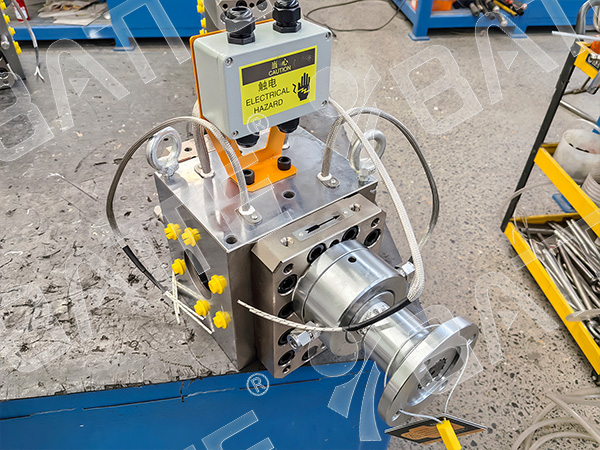
III. Straightforward Summary
Without a melt pump: The extruder must both plastify and pressurize the material, resulting in inconsistent output, high defect rates, high power consumption, and rapid screw wear.
With a melt pump: The main unit focuses solely on melting the material, while the pump delivers a precise and stable flow. This ensures consistent product quality, higher output, lower power consumption, and reduced maintenance costs—with a quick return on investment.
Applicable Industries
Cast film | PC/PMMA optical sheets | Pipes and profiles | Modified pelletizing | Rubber extrusion | Multilayer co-extrusion | Chemical fiber spinning
Email: sale@meltpump.com
WhatsApp: +86 158 3833 1071